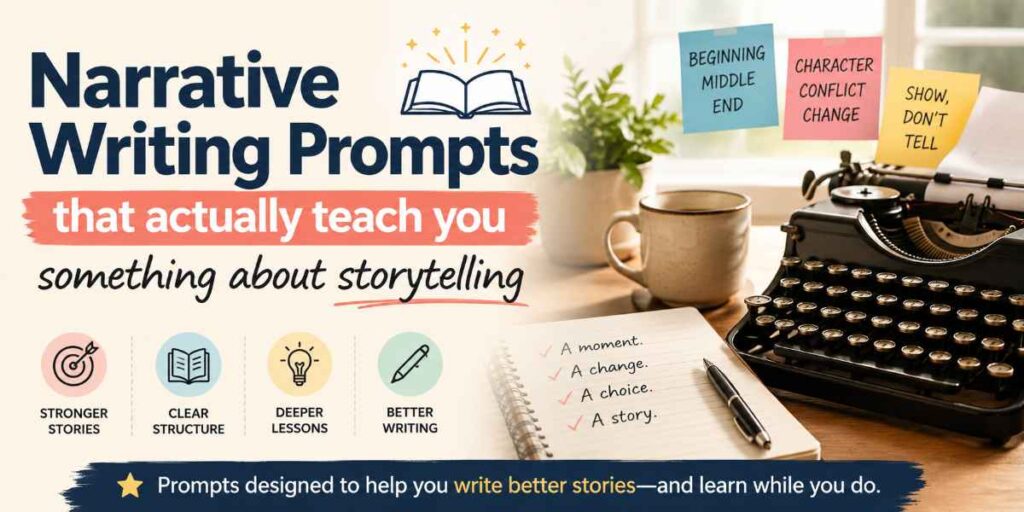
Most narrative writing prompts are just a topic with a period after it. “Write about a time you were scared.” Fine. Now what?
A good narrative prompt does more than hand you a subject. It points you toward a moment, a change, a specific person feeling a specific thing, so you’re not staring at a blank page wondering where a story even starts. That’s the difference between a prompt that gets used once and deleted and one that actually teaches you something about how stories work.
Narrative writing centers on telling a story from a specific point of view, usually built around a clear beginning, middle, and end rather than a loose collection of facts. Every narrative writing prompt below is built with that shape in mind: a moment, a shift, a reason it mattered.
Table of Contents
What actually makes a narrative prompt work
Before the lists, three things separate a prompt worth using from one you’ll skim past.
It points at a turning point, not a topic. “Write about your childhood” is a topic. Write about the day you stopped believing you were the fastest kid in your grade” is a turning point. One of those has a story hiding in it already.
It implies a change. Somebody wants something and doesn’t have it, and the story is what happens in between. If nothing shifts between the first line and the last, it’s a description, not a narrative.
It leaves room, but not too much. “Write about anything” is paralyzing. Write about a lie that got out of hand” gives you a lane without dictating every beat.
Narrative writing prompts for any writer
Pick one, set a 15-minute timer, and don’t stop to edit. First drafts of narrative prompts are supposed to be messy.
Everyday moments that hide a story:
- Write about the last time you changed your mind about someone.
- Write about a meal that meant more than the food on the plate.
- Write about the first time you noticed a parent was just a person.
- Write about a small kindness from a stranger you never saw again.
- Write about the version of a routine that finally broke.
- Write about waiting for news and what you did with your hands while you waited.
Turning points and decisions:
- Write about a choice you made in under ten seconds that changed something.
- Write about the moment you realized you’d outgrown a friendship.
- Write about the last time you were the youngest person in a room and the first time you weren’t.
- Write about a promise you kept even after it stopped making sense to you.
- Write about the conversation you rehearsed but never had.
- Write about a risk that didn’t pay off and what you did the next morning.

Imagination and what-if:
- Write about a character who inherits a house with one locked room and the year they finally open it.
- Write about the last ordinary day before everyone in a small town learns the same secret.
- Write about someone who can hear one specific kind of lie, and nothing else.
- Write about a letter that arrives 40 years late and who it finds.
- Write about the first person to notice something in the sky is wrong.
Quick prompts for when you have 10 minutes, not 60:
- Start with the line “I should have said something sooner.”
- Write a story that ends with someone finally putting a bag down.
- Write about a door that’s easier to open than to walk through.

Personal narrative writing prompts
Personal narrative writing prompts pull from your own life instead of an invented one. They’re the backbone of memoir, college essays, and personal blog writing, and they only work when you go specific instead of general. “I learned a lot from my grandmother” is a summary. A single afternoon with her, told in detail, is a story.
- Write about a physical object you’ve kept for years and what it would say if it could talk.
- Write about the moment you realized a childhood memory wasn’t quite true.
- Write about the last time someone believed in you before you believed in yourself.
- Write about a mistake you made that nobody ever found out about.
- Write about the person who taught you something without meaning to.
- Write about a place that doesn’t exist anymore and the last time you were in it.
- Write about the smallest decision that ended up mattering the most.
- Write about a time you were completely wrong about someone and when you found out.
- Write about the last day of something before you knew it was the last day.
- Write about a fear you don’t have anymore and what changed.
If you’re using these for a personal essay with real stakes, like a college application, the same rule from earlier applies twice as hard: pick the smallest possible moment that still carries the whole point. One specific Tuesday beats five vague years every time.

5th grade narrative writing prompts
Fifth grade narrative writing sits at a specific point in a kid’s development as a writer. By this grade, the expectation isn’t just “tell a story.” Common Core’s writing standards for grade 5 call for using dialogue, pacing, and concrete sensory detail to develop events, along with a conclusion that actually follows from what happened, not just a story that trails off. Good 5th grade narrative writing prompts should nudge kids toward all of that without the prompt itself feeling like a worksheet.
- Write about a time you were sure you were right and found out you weren’t.
- Write about the best (or worst) surprise anyone ever planned for you.
- Write a story where the weather changes everything about someone’s day.
- Write about a time you had to make a decision fast, with no time to ask an adult.
- Write about the day a rule got broken, on purpose, for a good reason.
- Write a story that starts with finding something that doesn’t belong to you.
- Write about the funniest thing that happened at school this year, told like a real story with a beginning, middle, and end.
- Write about a time you were brave even though you were scared.
- Write a story where a character has to explain something using only actions, no talking.
- Write about the last day of summer, from the point of view of someone who didn’t want it to end.
For teachers: pair one of these with a quick reminder to include at least one line of dialogue and one sensory detail (something a character sees, hears, or feels), it directly targets what the grade-level standard is actually asking for, and it gives kids something concrete to check for when they revise.

How to actually use these
Read the prompt once, then don’t reread it while you write. Rereading it invites you to write toward what you think it wants instead of what actually comes to mind first.
Start in the middle of the moment, not with the throat-clearing. Skip “It was a normal day until…” and just start with the thing that happened.
If you get stuck, describe what a character’s hands are doing. It sounds strange, but physical detail almost always unsticks a scene faster than trying to think your way out of it.
Common mistakes these prompts can’t fix for you
Even a great prompt can’t save a story that starts too early. If your first three sentences are setup, cut them; start where the tension starts.
Watch for narration that tells the reader how to feel (“it was the scariest moment of my life”) instead of showing what made it scary. The detail should do that work, not the label.
And don’t resolve everything in the last line. A narrative can end on a small, specific image and let the reader sit with it; it doesn’t need a neat moral wrapped around it to feel finished.
YOU MAY ALSO LIKE: BEST HINGE PROMPTS


One Comment